Weekly essays from Dr. Michael "House" Housman: stories from inside client engagements, the tools we actually use, and the practical playbook for moving from AI-curious to AI-native. No fluff, no jargon, no hype cycles.
By subscribing you agree to receive Dr. Housman's AI field notes by email. No spam, unsubscribe any time. See our Privacy Policy.
The dominant narrative says AI is coming for the jobs. But a new Ramp study — backed by independent research from PwC, LinkedIn, and economists at Yale, Northwestern, and MIT — tells a different story: the companies investing seriously in AI are hiring more, not fewer.
Read post →No kid dreams of becoming a keynote speaker and AI trainer — I certainly didn't. Here's the actual story of how I ended up in the tiny sliver between technical depth and human connection, and why that overlap is exactly where to future-proof your career as AI gets smarter.
Read post →The one-person unicorn made headlines — then got messy. But the underlying shift is real: AI is showing up as actual entries on the org chart, not just tools people use. Here are three ways it's landing, and why it's HR's whole job description changing.
Read post →A new OpenAI paper on Codex usage is the clearest data yet on where agentic AI is heading — and the gap between what the tools can do and how most teams actually use them is staggering.
Read post →Same technology, same access, radically different outcomes. A new Harvard Business School and University of Oregon study of 199 startup founders found that what separates the AI winners isn't better beliefs about the tech — it's a willingness to experiment and redesign work around it. Mindset, quantified.
Read post →Anthropic's Claude Fable is back online after a brief pause — and early benchmarks say it's a stair-step, not an increment. It can now run autonomously for a full day on a single task. Here's why we're living inside the exponential, and why the gap between what the tools can do and what most people do with them keeps widening.
Read post →Nearly every senior leader thinks they have a handle on where their organization stands on AI. Very few actually do. A free, 2-minute AI Readiness Assessment scores your leadership team across the 5 dimensions that predict whether AI actually sticks.
Read post →I haven't read an AI news article on its own website in months — and I'm catching more, not less. Here's the three-bot Zapier setup that reads the internet for me, filtered through my own book and my own voice.
Read post →We don't interact with AI the way we use a calculator — we collaborate with it the way we work with a colleague. And that means giving our agents three very human things: memory, personality, and culture. What I learned building House Party.
Read post →Where should AI lead, and where should it follow? The two most humbling creative decisions I made this year — scrapping an AI-first draft of my book, and recording the audiobook myself in a closet — and why staying human was worth it.
Read post →Everyone's chasing an "AI-first culture." But culture is the outcome, not the input — you build it through reps, not memos. Why AI adoption is a fitness journey, not a one-night stand.
Read post →A CEO leans in after a keynote: "My people just aren't leaning into AI." Then I ask what their own AI practice looks like — and the room goes quiet. Adoption isn't a tooling problem. It's a leadership one.
Read post →Enterprises poured $30–40 billion into generative AI in 2025 — and only 5% are seeing measurable returns. The gap isn't strategy; it's people. Why successful adoption comes down to mindset, skillset, and toolset working together.
Read post →A panicked Wednesday, a forgotten flyer, and an hour of "directing" an AI designer like a junior creative. The result: a finished asset I never could've built myself, and a reminder that the barrier to entry just got obliterated.
Read post →By far the most common question after every talk isn't about neural networks. It's about somebody's kid. Here's the two-part answer I now give every parent staring down an entry-level hiring freeze.
Read post →Inside the UT Exec Ed AI workshop with ESCP and IPADE: how MBA cohorts compressed a 6-month, $100K product process into 90 minutes, and how an "AI Shark Tank" gave them the brutal feedback no human investor would.
Read post →My first political keynote, for Senator Ruben Gallego. The data: 22% of voters rank immigration as their top issue, but you're 14x more likely to lose your role to an AI agent. We're arguing about the border while the labor market shifts underfoot.
Read post →My friend Josh had the budget and the plan to hire a whole research team for his new ETF. He hired no one. Instead he built an agentic system that pressure-tests his thesis better than any junior analyst could: a live case study in every framework from Future Proof.
Read post →Launch day. Plus an excerpt on the math that changes everything: why a 1% completion rate isn't slow, why "the perfect wave" usually means the missed wave, and why "exponential" is the only number that matters now.
Read post →Why I went heads-down for a year to write Future Proof, and the opening case from the book: how PetLab went from 40 minutes per campaign to 5, from 500 ad creatives a month to 2,200, and from "fast-growing brand" to acquired.
Read post →
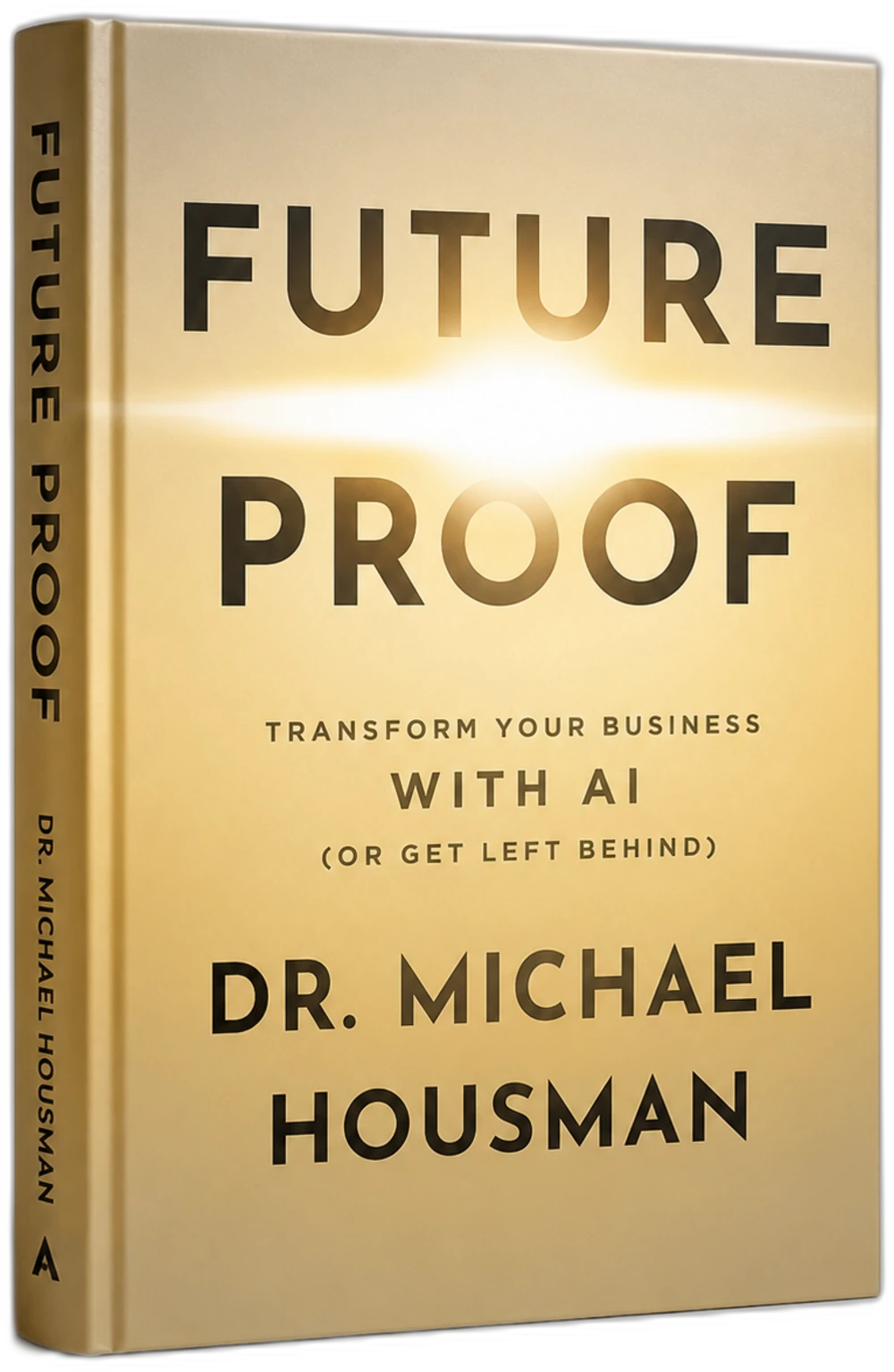
The full field guide to riding the AI wave instead of getting crushed by it: non-technical, jargon-free, and endorsed by Marshall Goldsmith, Nir Eyal, John Rossman, Adam Alter, and Senator Ruben Gallego.
Start with the opening case: how PetLab leveraged a handful of off-the-shelf AI tools to take their marketing engine from 40 minutes per campaign to 5, and from "fast-growing brand" to acquired.
Download the Sample Chapter