Hi all,
When I deliver workshops, I run into the same negative perceptions about AI over and over. Fear that it'll take jobs. Skepticism because it failed once ("we tried it, it hallucinated, we moved on"). Concerns about data privacy, security, and governance.
All understandable. But a big part of my job is getting folks excited about the possibilities — that this technology will create many new jobs, automate the most mind-numbing parts of our current ones (leaving us the fun, human pieces), and make entirely new kinds of work possible.
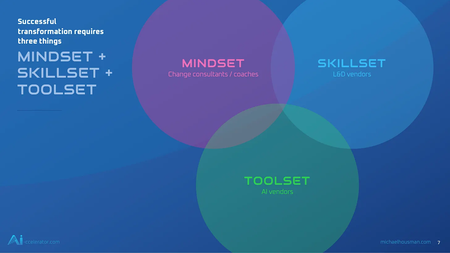
This is the mindset piece of the toolset-mindset-skillset triad we address at the AI Performance Lab. If people aren't excited to dig in — if they're being forced to do it — it's never going to stick. It's like loving yoga and being told you can only run on a treadmill. You'll comply for a couple weeks and then quietly stop showing up.
And now there's research showing that mindset isn't just a soft, feel-good concept. It shows up in the numbers.
The Research
A new working paper from researchers at Harvard Business School and the University of Oregon surveyed 199 tech startup founders — arguably the group best positioned to benefit from AI — about how AI has changed their firms.
Three findings jumped out at me:
The gains are wildly uneven. On average, founders estimated they'd need 55% more employees to maintain output without AI. But the median was just 17% — and 30% of founders said they'd need zero additional employees. Same technology. Same access. Radically different outcomes.
The founders who commit see ~4x the benefit. Founders who formally integrated AI into their workflows estimated they'd need 91% more headcount without it. Founders whose employees just casually use AI? 24%. Nearly four times the impact — for making AI a deliberate part of how work gets done rather than something people dabble with.
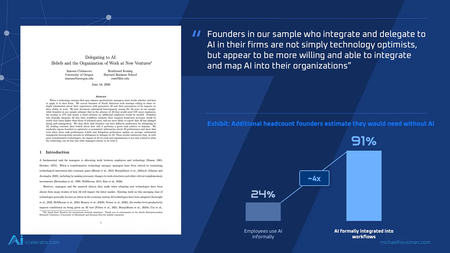
- Here's the kicker: it's not about believing the tech is better. The researchers ran an experiment to test whether the deep integrators were simply more optimistic about AI's capabilities. They weren't. Beliefs about how well AI performs explained only about a third of the variation in willingness to delegate work to it. What actually distinguished the high-performers was a willingness to experiment — to redesign work around the technology and try things.
In the authors' words: the impact of AI "is not only related to what the technology can do but also what managers choose to do with it."
That's mindset. Quantified.
The Keynote + Workshop Combo
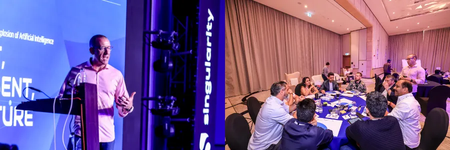
Something I've learned from delivering hundreds of in-person workshops around the world: you have to pair keynotes (which shift mindsets) with hands-on workshops (which develop skillsets). Doing one without the other never achieves the same impact. When you combine the two, it's magical.
The keynote gets people leaning forward — excited instead of afraid. The hands-on workshop converts that energy into actual capability before it dissipates. Excitement without skills fades. Skills without excitement never get used.
If your organization is just buying the technology and handing out Coursera subscriptions, you're missing the biggest piece of the equation. The mindset piece is critical — and there aren't many out there who can create genuine excitement about AI and couple it with the technical skills development everyone needs to keep adapting to a constantly changing landscape.
That's exactly what we built the AI Performance Lab to do.
If you want to learn more about how this works — for organizations that want their leadership to stay ahead of AI, not fall behind — just hit reply. I'd love to walk you through it.
Best, Dr. Michael "House" Housman