Hi all,
I've been thinking a lot about how AI changes our relationship with work.
Not the "will it take my job" question. Something more personal: what it does to the thinking muscle of the person using it. Because if AI is quietly making your team faster and shallower at the same time, that's a problem no productivity dashboard will catch.
Your brain on ChatGPT
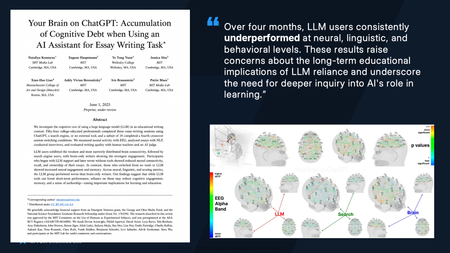
Researchers at the MIT Media Lab strapped EEG headsets on 54 people and had them write essays over four months. One group used ChatGPT, one used a search engine, one used nothing but their own head.
The brain-only group lit up the most. The search group was in the middle. The ChatGPT group showed the weakest neural connectivity of all, up to 55% lower than the unaided writers in the networks tied to meaning-making and self-monitoring. And it got worse with each session: by the third round, most of the AI group was mostly copying and pasting. When asked to quote a single sentence from the essay they'd finished minutes earlier, 83% of them couldn't do it.
None of this should surprise us. Our brains happily abandon a skill the moment technology seems to have it covered. Nobody under 40 can read a paper map. I'm fairly sure my driving has atrophied since I started letting my Tesla do the work, though my dad and my siblings would argue that's mathematically impossible given where I started.
But here's the twist: AI doesn't make work easier
You'd think a tool that does your thinking would at least lighten the load. The opposite is happening. ActivTrak tracked 10,584 workers before and after they adopted AI. Time on email doubled. Time in messaging apps went up 145%. Time in business software rose 94%. Deep-focus sessions fell 9%. People didn't use the saved time to do less. They took on more, multitasked more, and squeezed work into evenings and waiting rooms.
So we have two studies pointing in opposite directions: one says AI makes people think less, the other says it makes people work more. Put them together and you get a workforce that's busier and less engaged at the same time.
The divide that actually matters
David Brooks wrote a piece in The Atlantic this summer that resolved this for me. His argument: AI isn't going to widen the gap between rich and poor nearly as much as it widens the gap between people who use AI to think more and people who use it to think less. He calls it cognitive polarization. His line that stuck with me: "When intelligence is plentiful, volition is valuable."
I see this every week in workshops. Some people are using AI to delegate. Hand it the task, take the output, move on. The people getting the most out of it are using it as a thought partner. I run every call, deck, and proposal past Claude and ask for blunt feedback before it goes out. It's a brainstorming companion and a sparring partner, not a vending machine.
Jensen Huang made the same point when Fareed Zakaria asked him whether AI was making people dumber:
"I'm not asking it to think for me. I'm asking it to teach me things that I don't know or help me solve problems that I otherwise wouldn't be able to solve... In order to ask good questions, it's a highly cognitive skill. And as a CEO, I spend most of my time asking questions."
The trait that separates the two groups
I've believed for a long time that the thing separating the high-thinkers from the low-thinkers in the AI era is curiosity. Curious people don't just use AI more effectively. They point it at more ambitious problems, because the tool finally makes those problems reachable. Curiosity is going to be the dividing line between the AI haves and have-nots.
Which is why I was thrilled to join my friends at EY on The Curious Advantage podcast last week. It's a fun, far-ranging conversation about why technology is easy and people are hard. Have a listen.
One thing to try this week
Before you ask AI for an answer, write your own first. Then hand it over and ask AI to tear it apart. Same tool, completely different brain activity.
And I'd love to know: how do you use AI? As a substitute for your own thinking, or a complement to it? Hit reply with and let me know your thoughts. I read every response.
Best,
Dr. Michael "House" Housman