Hi all,
Two years ago, when I mentioned the "one-person unicorn" in my talks — Sam Altman's bet that AI would let a single founder build a billion-dollar company — it usually got a laugh. Fan fiction, not forecast.
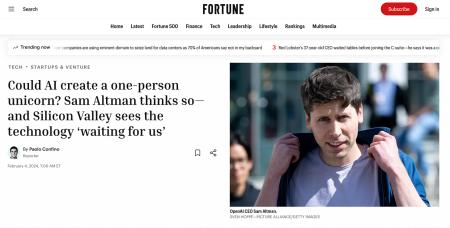
Then, this April, the New York Times profiled Medvi, a telehealth start-up that used AI to write its code, produce its ads, and run customer service — with a total headcount of two. $1.8 billion in projected sales. Altman himself said it looked like he'd won his bet.
Then it got messy. Futurism reported that some of that growth was propped up by AI-deepfaked doctors running social ads, faked before-and-after patient photos, and an FDA warning letter. The unicorn story cracked open fast.
I still think we get there — maybe not with two people, maybe not this way. But the underlying shift isn't in question. Technology always reshapes how we communicate, organize, and work, and I've written before about the clearest tell it's already happening: agents showing up as real entries on the org chart, not just tools people use.
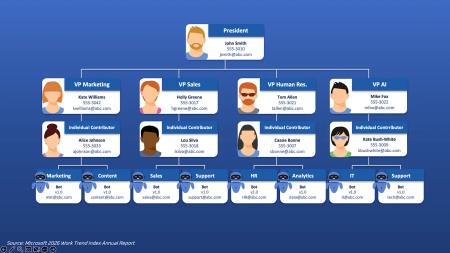
Here's where I see it actually landing — three shifts, and my own read on each.
1. Smaller crews, same output.
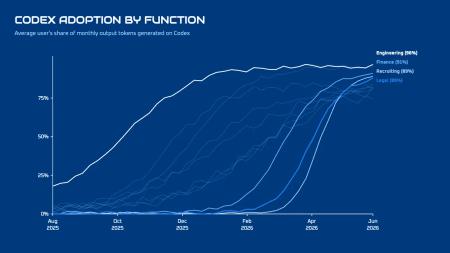
Iteration doesn't wait on a person anymore. I hand my designer less and less because I can iterate with Claude in real time instead of round-tripping through someone's calendar. OpenAI's own internal data makes the same point at scale: legal, recruiting, and finance teams — not engineers — now generate the majority of their output with Codex, and over a quarter of what non-engineers do with it is actual engineering. People who used to file a ticket and wait are just doing the thing now.
2. One person, three jobs.
Once anyone can build, wide beats deep. Meta just cut roughly 8,000 jobs and pushed manager-to-employee ratios as high as 1-to-50 in some divisions — the bet being that a smaller group of people working alongside AI can do what used to take entire layers of coordination.
And the coordination piece isn't just shrinking — it's getting automated outright. At AI Performance Lab, we run swarms of agents that post project updates, flag when a timeline's about to slip, and recommend a fix — in real time, continuously. It's a project manager on steroids that never sleeps and is obsessed with one thing: hitting the deadline. That's not a hypothetical for us. It's how we already run our own projects.
3. The org chart's middle is disappearing.
Fewer layers exist to move information up and down, because the information doesn't need to travel that way anymore, and the shape this takes is small, nimble "tiger teams" that get handed a project or product and execute on it independently, with far less need to check in up a chain of command.
The open question is how those teams coordinate with each other — and that's exactly what Jack Dorsey is testing at Block. After cutting roughly 40% of Block's workforce this spring, Dorsey and Sequoia's Roelof Botha laid out a model built around "Directly Responsible Individuals": people who own a specific outcome for a defined window, pull whatever resources they need, and answer to an AI-maintained "world model" instead of a manager. No permanent middle layer. Just teams and a system that knows what everyone's doing.
The bottom line
Put these three together and the org chart itself changes shape — smaller boxes, wider titles, fewer layers between an individual contributor and the top. That's not an HR footnote. It's HR's whole job description changing: workforce planning, career ladders, comp bands, and management itself all get rebuilt around this. CHROs who treat this as a tooling rollout are going to be way behind the ones who treat it as a redesign.
I'd love to hear where you're seeing this show up in your own org — hit reply and tell me.
Best, Dr. Michael "House" Housman