A couple weeks ago, I was in a room with 20 executives at one of the biggest companies in the world. I asked a simple question: who here has actually used an AI agent? Not ChatGPT, an agent that goes and does the work?
Three hands went up. When I asked what they'd used it for, all three described something closer to a thought partner than a coworker: brainstorming, drafting, back-and-forth. Not one was handing off real work and walking away.

My buddy Sonny Tambe (Wharton, and one of the authors) just helped OpenAI publish a new paper analyzing usage of Codex, their agentic coding tool, across three groups: outside individuals, outside organizations, and OpenAI's own employees. OpenAI's own write-up is a faster read if you want the highlights first. It's the clearest data I've seen yet on where this is all actually heading.
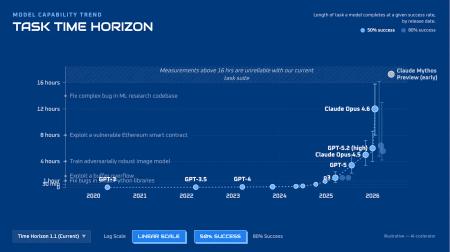
Agents can now run for hours. You kick off a job and check back later.
That's not a minor UX upgrade — it's a different way of working. The paper tracked how long Codex runs unattended: the median OpenAI employee now has agents active for 2.5 hours a day, with the heaviest users running multiple agents in parallel for well over a full workday's worth of hours. Since December, the share of individual users who handed Codex a task that would've taken a human 8+ hours jumped from 2% to over 25%.
You're not chatting with this thing anymore. You're delegating to it and coming back later to check the work.
Most people and companies aren't close to using this at capacity.
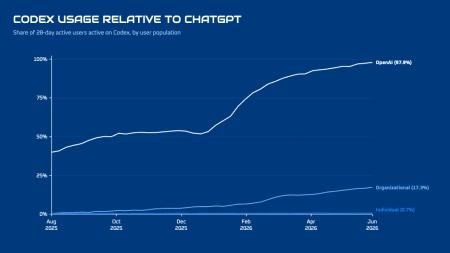
I've said this before: the technology is sprinting, and the average user is falling further behind, not catching up. The data backs it up starkly. Among everyday individual users, fewer than 1% have even touched Codex in the last month. Compare that to OpenAI's own employees, where it's basically everyone.
OpenAI is the case study for what "AI-native" actually looks like.
This is the part I find most useful, because it's not a hypothetical — it's a company showing its own homework. Inside OpenAI, Codex now accounts for 99.8% of the AI output its employees generate, having almost completely replaced ChatGPT for work. Outside organizations are only at 63%. Solo individual users are at 16.5%. Same tool, wildly different level of commitment.
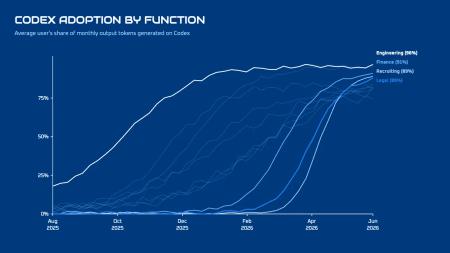
And this isn't a developer story anymore.
That's the part that should get every non-tech company's attention. Legal, recruiting, and finance teams inside OpenAI have all crossed over to Codex as their primary tool now too — not just the engineers. Outside OpenAI, non-developer usage is growing faster than developer usage: up 189x at the organizational level and 137x for individuals since last August. The tool jumped the fence from "thing engineers use" to "thing everyone uses" a while ago. Most companies just haven't noticed yet.
Which brings me back to that room of 20 executives. None of them work at a tech company. Doesn't matter. The tools don't care what industry you're in — they care whether you've handed them real work yet.
If your team is still using AI as a thought partner and not as a coworker you assign tasks to and check back on, you're not behind because the technology isn't ready. You're behind because you haven't started delegating yet.
I'd love to hear what your teams are actually delegating to agents right now, if anything — hit reply and tell me.
Best,
Dr. Michael "House" Housman