Hi all,
People ask me all the time how I ended up doing this for a living. It's a weird gig. No kid grows up dreaming of being a keynote speaker and AI trainer. I certainly didn't.
Here's the actual story. Years ago, Singularity University got wind of me through a friend — they're constantly hunting for people who can hold a room and unpack technical content about exponential technologies. I got invited to deliver a tryout, did well enough, and they handed me my first real shot: a live gig in front of Deloitte.
It did NOT go well.
I remember sitting there watching the speaker who went on after me and thinking, "wow, that guy bombed." Then the feedback scores came in. His was slightly higher than mine. Humbling doesn't begin to cover it.
The Two Things That Saved Me
Singularity did two things that changed the trajectory of my whole career. First, they invited me back anyway. Second, they gave me real feedback scores after every single talk.
I read every comment. Every one. My goal was simple: get 5% better each time. Slowly, talk after talk, the scores climbed — from something like a C average up to the point where I'm now consistently near the top of the pack.
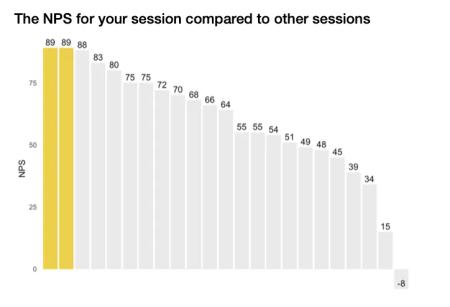
That discipline — read the feedback, make the change, do it again — is still how I run my business today: take your ego out of the equation, see feedback as an opportunity to improve, make changes, observe the impact.
But There's a Second Reason I Ended Up Here
Somewhere in the middle of building data science models and leading engineering teams, I picked up a different skill almost by accident: I could actually explain this stuff to people who didn't build it.
Turns out that's rare. And if you're trying to sell an AI platform into the C-suite, making complex concepts accessible is the whole ballgame. I sharpened that skill the same way — meeting after meeting, always asking stakeholders what landed and what didn't.
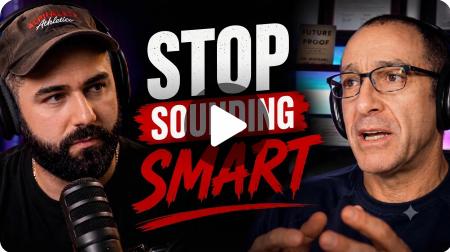
I recently sat down for a podcast where I get into exactly this: why explaining technical ideas in plain language matters more than being technically right, and what it actually looks like to meet your audience where they are. Have a listen.
The Tiny Sliver in the Middle
There are a ton of smart, technical people out there. There are also a ton of futurists who can blow your mind about where AI is headed. But the overlap between those two circles is small — and that's the niche I've somehow ended up living in.
Where did that come from? Honestly, I think I started at an early age. My mom was a schoolteacher with a gift for making complicated things simple. My dad thinks in pure logic, numbers, and systems. I ended up living right in the overlap of the two of them — which is exactly what I wrote about in the dedication of Future Proof (full version is at the bottom if you want it).
Here's why I think this matters more now than it ever has. AI is quickly turning a lot of technical skills into table stakes — the models can write the code, crunch the numbers, and generate the analysis faster than any of us can. What they still can't do is read a room, tell a story that actually lands, or make a stranger care about something in the first ninety seconds. That's the part that doesn't get commoditized. If you're trying to future-proof your own career, this is exactly where to put the energy.
It also happens to be exactly the philosophy behind the AI Performance Lab. You can deliver a keynote that blows people's minds, but if it doesn't turn into action, it evaporates by Monday. You can hand out laptops and walk a room through hands-on exercises, but if nobody's excited about where this is headed, it won't stick either. You need the toolset, the mindset, and the skillset together — and very few companies out there are built to deliver all three.
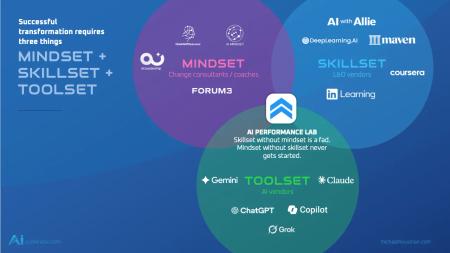
If any of this is relevant to your team, hit reply — I'd love to talk it through.
Best,
Dr. Michael "House" Housman
From the dedication of Future Proof*:*
For my parents.
My mother, Jeri Lou Housman, was a schoolteacher, a mother of six, and a born educator. Though she passed away when I was eleven, her gift for simplifying the complex and her instinct to serve others continue to guide my work.
My father, Robert Housman, lives in the realm of numbers, logic, and systems. His mathematical brilliance shaped how I think, reason, and build — and gave me the confidence to work fluently with machines.
This book exists because of both of them. It reflects the space where their worlds meet: data and explanation, logic and empathy, intelligence and humanity.