A new study just landed that confirms something I've been saying from stages for years.
You know the dominant narrative. CEOs announce layoffs and blame AI. Headlines predict a white-collar wipeout. Every LinkedIn feed has someone declaring that hiring is over.
Ramp — the corporate card company — just published something that cuts through all of it. Instead of surveys or predictions, they looked at actual AI spending on 21,559 companies' corporate cards, then linked it to workforce records to see what happened after firms started paying for AI. Not what executives said about AI. What they spent, and who they hired.
The result: companies making serious AI investments grew headcount by 10.2% in the two years after adoption. Entry-level jobs — the ones everyone assumes are getting automated away first — grew even faster, up 12%. And the gains showed up almost everywhere: sales, engineering, admin, customer service.
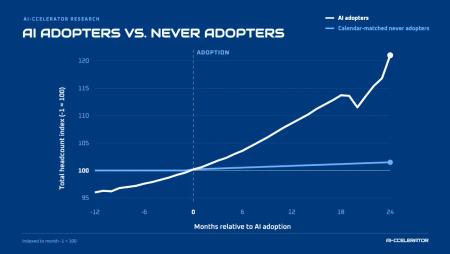
Their conclusion, verbatim: "If you are reading headlines where CEOs blame layoffs on AI, be skeptical."
And Ramp Isn't Out on a Limb
The remarkable thing is how many independent research teams are landing in the same place.
PwC analyzed over a billion job ads across six continents and found headcount growing fastest at the most AI-exposed companies. Their words: "Far from being a job killer, AI may actually be a job expander."
A team of economists from Yale, Northwestern, and MIT published the most rigorous causal study yet: when firms adopt AI, revenue, productivity, profits, AND employment all rise. Yes, AI takes over individual tasks — but the firms grow enough to more than make up for it.
LinkedIn's data counts 1.3 million brand-new AI-related roles created globally in just two years — job titles that didn't exist before, like "Head of Human AI Solutions". And the Wall Street Journal ran the headline: "Big Companies Are Starting to Hire Again, Defying Predictions of AI Wipeout."
The Economics Behind It
Stanford's Erik Brynjolfsson — probably the world's leading economist on AI and work — calls the doom logic the "lump of labor fallacy" in a recent interview: the assumption that there's a fixed amount of work, so if AI does more, humans do less. History keeps breaking that assumption. When jets made pilots dramatically more efficient, we didn't need fewer pilots. We flew constantly. Demand exploded to absorb the new capacity.

I heard an interviewer put it to him recently in terms every executive should tattoo somewhere visible: "If I had engineers who could write 10 times as much code, I would hire more engineers, not fewer."
That's the pattern in the Ramp data. Productivity gains make growth cheaper, and growth means hiring. AI doesn't shrink the pie. It creates opportunities that didn't exist before — new products, new services, new roles.
The Catch: Casual Adoption Gets You Nothing
One more finding from the Ramp study that's worth calling out: The hiring gains only showed up at high-intensity adopters — firms spending about $34 per employee per month on AI. Firms that dabbled (a few ChatGPT seats, around $3 per employee) saw zero change. And the gains followed a learning curve: flat for the first six months, then compounding — up 7% by month 6, 21% by month 12, 32% by month 18.
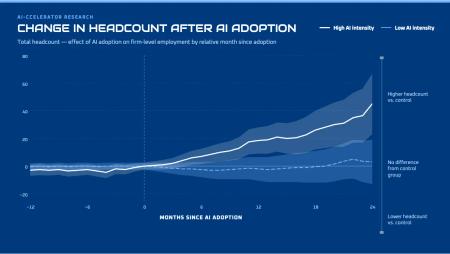
That matches exactly what I see inside companies every week. The value doesn't come from buying subscriptions. It comes from the unglamorous months after: finding use cases, redesigning workflows, building the muscle. The companies that push through that phase grow. The ones that stop at the pilot get nothing and conclude "AI doesn't work."
AI isn't deciding whether your company grows or shrinks. Your level of commitment to it is.
If your organization is stuck in the dabbling zone — subscriptions bought, pilots run, nothing changing — that's exactly the gap we built the AI Performance Lab to close. Let's talk.